💧 Hyperhidrosis Treatment in Omiya | Personalized Treatment Plans Based on Your Symptom Type
This page is supervised and written by specialist physicians at IC Clinic Omiya, located just a 1-minute walk from JR Omiya Station East Exit.
💡 What You Will Learn from This Article
✅ Self-check whether your sweating concerns may be hyperhidrosis
✅ Explore suitable options from 7 treatment methods
✅ Get a clear picture of costs for both insurance-covered and self-pay treatments
✅ Visualize how daily life may change after treatment
⚠️ Are You Struggling with Your Sweating Alone?
😰 Your palms are soaking wet during presentations…
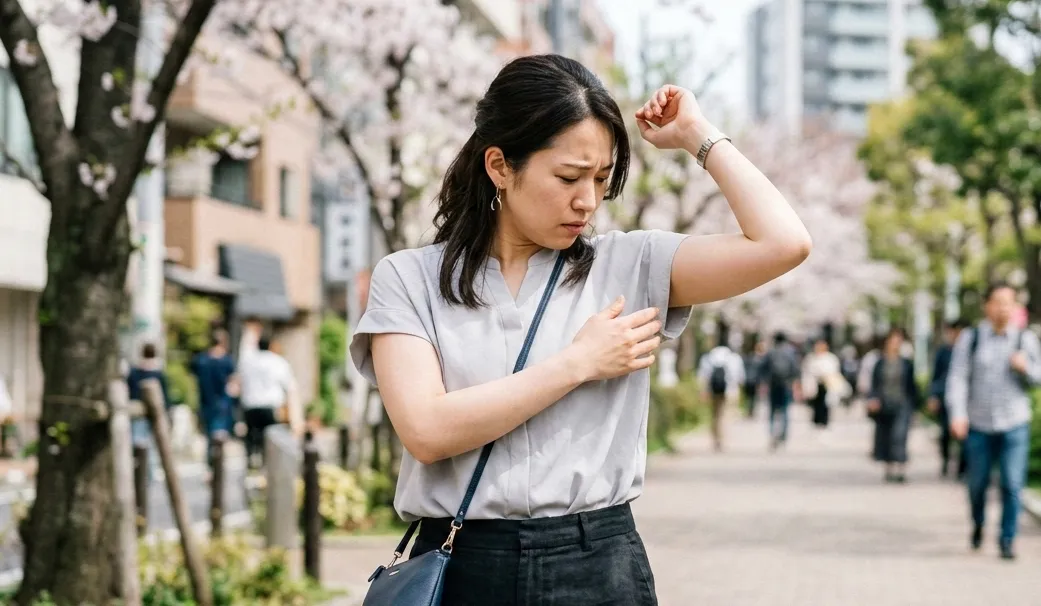
😰 You avoid gray and light-colored clothing because sweat marks show…
😰 You feel embarrassed holding onto straps on the train…
→ More and more people are finding relief from these concerns through appropriate treatment

🔍 Do You Need Treatment? Hyperhidrosis Self-Check
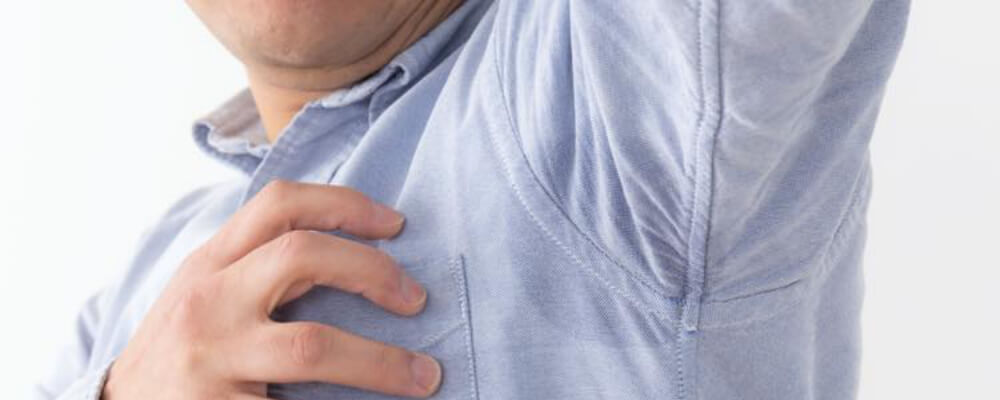
“Am I just a heavy sweater, or could it be hyperhidrosis?” — many people find themselves wondering exactly this.
If 3 or more of the following items apply to you, hyperhidrosis may be a possibility.
- ☑️ You sweat heavily from specific areas regardless of temperature or physical activity
- ☑️ You experience sweating that interferes with daily life at least once a week
- ☑️ Symptoms began before the age of 25
- ☑️ A family member has similar symptoms
- ☑️ Sweating stops during sleep
- ☑️ Sweating occurs symmetrically (both hands, both feet, both underarms, etc.)
Normal sweating is a physiological response for regulating body temperature, but hyperhidrosis is a condition in which excessive sweat is produced regardless of temperature regulation needs.
Specifically, examples include paper becoming wet when held, a keyboard becoming too damp to use, or socks becoming so soaked they could be wrung out.
We frequently hear from patients who say things like,
😢 “When someone asks to shake hands at an interview, I just want to flee,”
😢 “I hate myself for avoiding holding my child’s hand.”
Hyperhidrosis is a condition that can be improved with appropriate treatment. Let’s start by understanding your own symptom type.
👉 Learn more about how to self-check for hyperhidrosis
👉 Is Excessive Sweating a Sign of Hyperhidrosis? Causes and Treatment Explained
📋 Two Classifications of Hyperhidrosis | Different Treatment Approaches Based on Sweating Pattern
Hyperhidrosis is divided into two types based on the extent of sweating, each with different causes and optimal treatments.
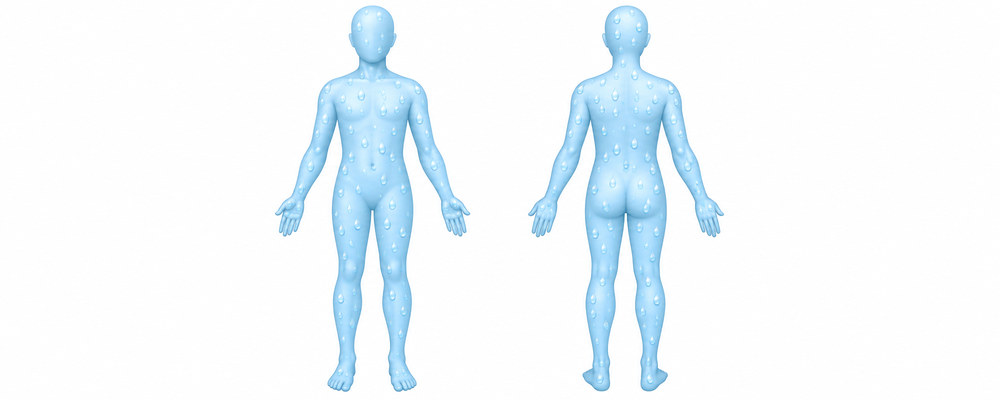
🌡️ Generalized Hyperhidrosis: Sweating Across the Entire Body
Generalized hyperhidrosis is a type in which sweating increases across a wide area from head to toe.
An underlying condition is often present, with hyperthyroidism, diabetes, and menopause being common examples. It may also appear as a side effect of medications being taken (such as antidepressants, corticosteroids, or NSAIDs).
With this type, addressing the underlying condition is important in addition to treating the hyperhidrosis itself.
👐 Focal Hyperhidrosis: Concentrated in Specific Areas | Learn More
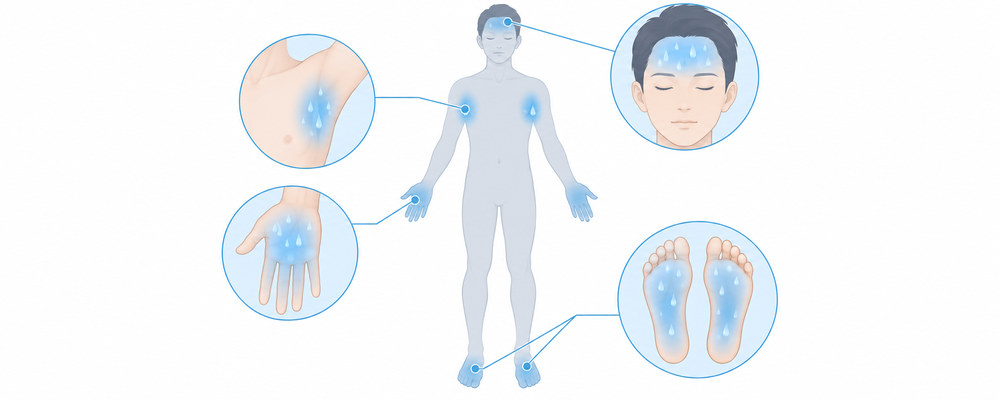
Focal hyperhidrosis is a type in which excessive sweating occurs only in specific areas with a high concentration of sweat glands, such as the underarms, palms, soles of the feet, face, or scalp.
The condition is named according to the affected area:
| Affected Area | Medical Name | Common Patient Concerns |
|---|---|---|
| 💪 Underarms | Axillary hyperhidrosis | Sweat marks on clothing, concern about odor |
| ✋ Palms | Palmar hyperhidrosis | Difficulty with documents, smartphones, and handshakes |
| 👣 Soles of the feet | Plantar hyperhidrosis | Wet shoes, risk of athlete’s foot |
| 😓 Face | Facial hyperhidrosis | Makeup running, feeling nervous in public |
| 🧠 Scalp/Head | Craniofacial hyperhidrosis | Hair becoming wet, sweat dripping down |
Most cases of focal hyperhidrosis are “primary,” meaning the cause is unknown. It is thought that psychological tension and stress cause the sympathetic nervous system to become overactive, which promotes sweating.
👉 Learn more about the relationship between hyperhidrosis and stress
👉 Severe Sweating on the Head and Face: Causes and Management of Craniofacial Hyperhidrosis
Genetic factors are also thought to play a role; some reports indicate that approximately 60% of patients have a family member with similar symptoms.
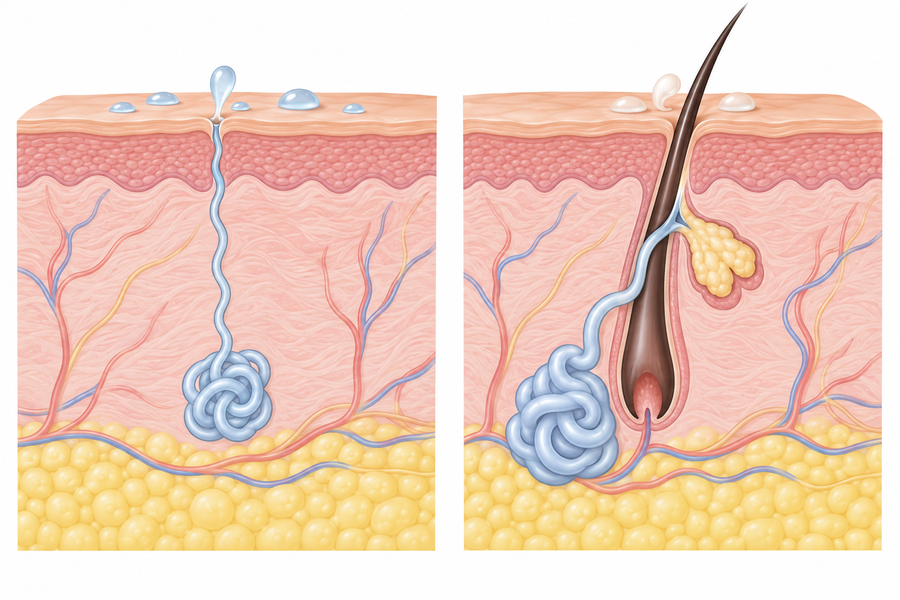
🔬 The Relationship Between Sweat and Odor | Can Hyperhidrosis and Underarm Odor Occur Together?
“Sweating a lot = underarm odor (axillary osmidrosis)” — this is a misconception.
Hyperhidrosis and axillary osmidrosis are often confused, but the types of sweat glands involved are fundamentally different.
| 💧 Hyperhidrosis | 🌸 Underarm Odor (Axillary Osmidrosis) | |
|---|---|---|
| Sweat Glands Involved | Eccrine sweat glands | Apocrine sweat glands |
| Characteristics of Sweat | Approximately 99% water, watery consistency | Contains proteins and lipids, slightly viscous |
| Distribution | Almost the entire body | Underarms, ear canal, areola, navel area, and genitals only |
| Odor | Naturally odorless | Produces a distinctive odor when broken down by bacteria |
Sweat from eccrine glands is naturally odorless, but when it mixes with sebum and dead skin cells on the skin’s surface and is broken down by resident bacteria, it can produce a sour-like odor.
Sweat from apocrine glands, on the other hand, is rich in fatty acids, ammonia, and other compounds that serve as nutrients for bacteria, producing a strong, distinctive odor when broken down.
👉 Learn more about the characteristics and symptoms of axillary osmidrosis
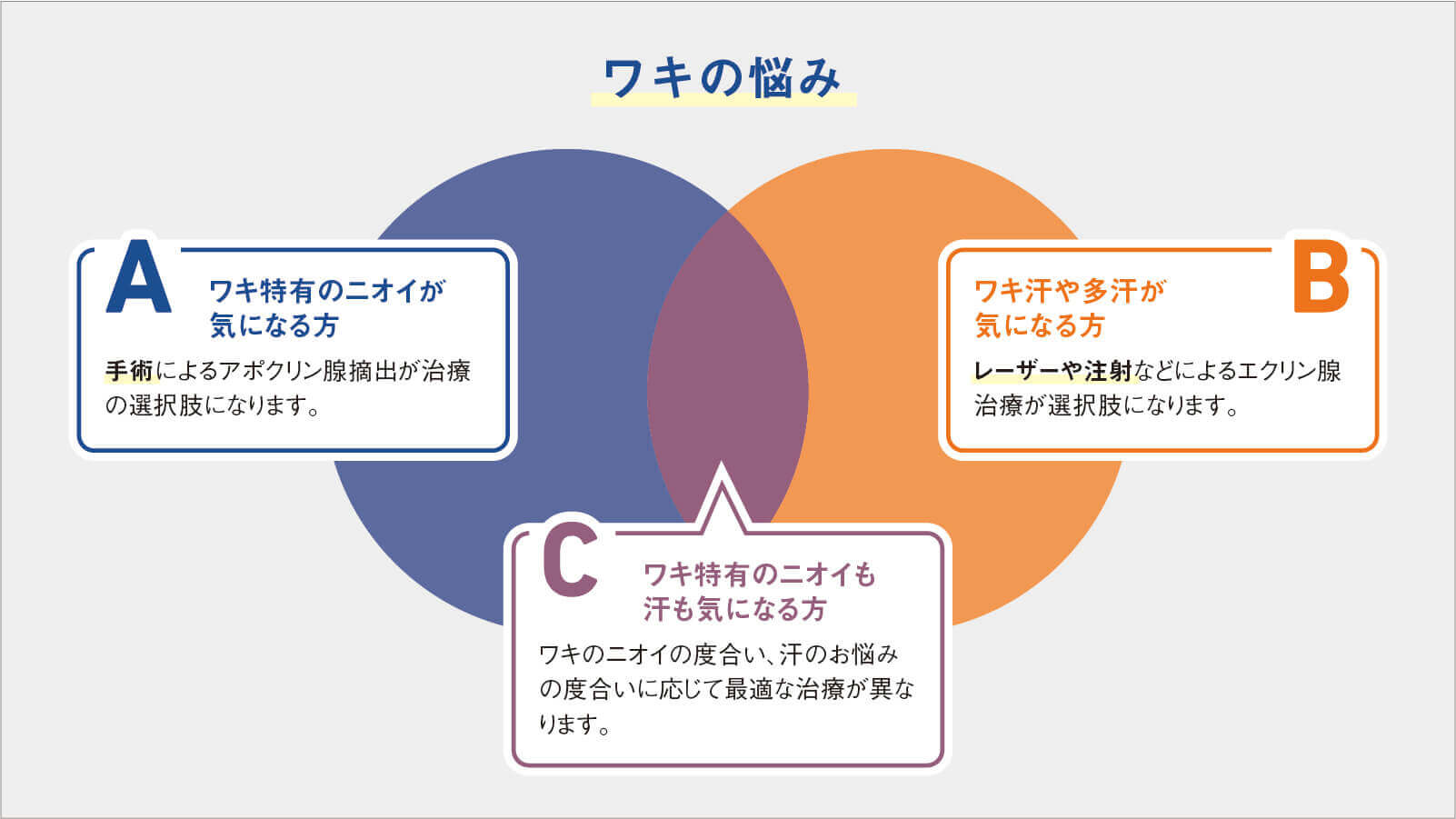
Hyperhidrosis and axillary osmidrosis can occur together, but they do not always go hand in hand. For those concerned about both, treatments that address both eccrine and apocrine sweat glands may be worth considering.
👉 Learn more about underarm odor (axillary osmidrosis) treatment
💉 A Comprehensive Comparison of 7 Hyperhidrosis Treatments | Matched to Symptom Severity
The optimal treatment for hyperhidrosis varies depending on the severity of symptoms and the affected area.
For mild cases, it is common to start with topical medication or oral medication, then step up to injections or device-based treatments if results are insufficient.
| Treatment | Suitable Symptom Level | Insurance Coverage | Estimated Cost | Duration of Effect | Visit Frequency |
|---|---|---|---|---|---|
| 💊 Topical Medication | Mild to moderate | ❌ | ¥1,500–¥2,200 / application | Only while in use | Approx. once a month |
| 💊 Oral Medication | Mild to moderate | △ Partial | From ¥2,200 / month | Only while taking | Approx. once a month |
| 🌿 Herbal Medicine (Kampo) | Mild | △ Partial | From ¥5,500 / month | Only while taking | Approx. once a month |
| 💉 Botulinum Toxin Injection | Moderate to severe | △ Severe axillary only | ¥22,000–¥55,000 / session | 4–9 months | 2–3 times per year |
| ⚡ Iontophoresis | Moderate (hands and feet only) | ✅ | Approx. ¥990 / session | Ongoing treatment required | 1–2 times per week |
| 🔪 Sympathectomy (ETS) | Severe (hands only) | ✅ | ¥132,000–¥165,000 | Long-lasting | 1 session |
| ⭐ miraDry | Moderate to severe (underarms) | ❌ | ¥220,000–¥440,000 | Long-lasting | 1–2 sessions |
The choice of treatment is determined by taking a comprehensive view of symptom severity, affected area, lifestyle, and budget.
The sections below explain the characteristics of each treatment in detail, so please use this information to prepare before your consultation.
👉 Types of Hyperhidrosis Surgery | Advantages and Disadvantages by Treatment
💊 Topical Medication (Aluminum Chloride) | An Accessible First Step
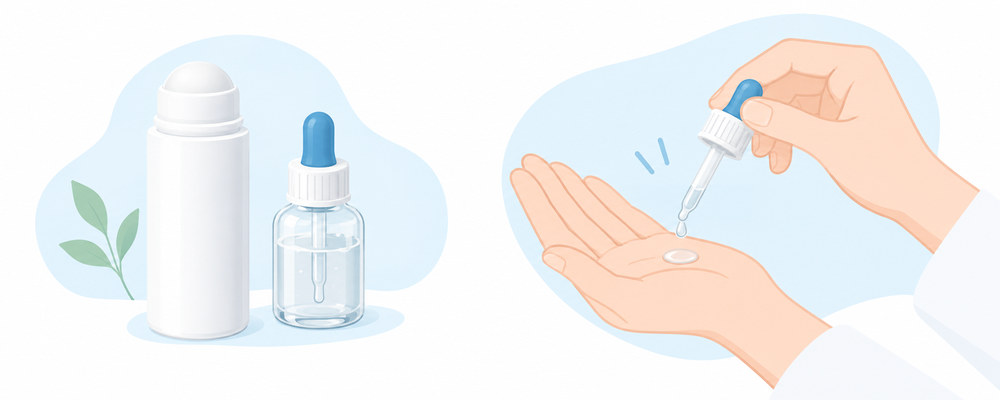
Topical medication containing aluminum chloride works by physically blocking the sweat pores to suppress perspiration.
The standard method is to apply the medication to the affected area before bed and rinse it off the following morning. Continued use for 2–3 weeks is generally needed before effects are noticeable, but once symptoms stabilize, application 2–3 times per week is typically sufficient for maintenance.
⚠️ Important to Know: The effects diminish when use is discontinued, so ongoing use is required. Those with sensitive skin may experience irritation or redness, so starting with a lower concentration is recommended.
💰 Cost: Depending on concentration, ¥1,650–¥2,200 (tax included) / Not covered by insurance
💊 Oral Medication (Anticholinergics) | Targeting Sweating Throughout the Body

Oral medications block the action of the neurotransmitter acetylcholine, thereby suppressing the signals that trigger sweating.
Main oral medications used in hyperhidrosis treatment:
- 💊 Propantheline bromide … The only insurance-covered option
- 💊 Oxybutynin … Not covered by insurance
- 💊 Solifenacin succinate … Not covered by insurance
⚠️ Important to Know: Efficacy can vary, and side effects such as dry mouth, constipation, drowsiness, and blurred vision may occur. Use may not be possible for elderly patients or those with glaucoma or benign prostatic hyperplasia.
💰 Cost: From ¥2,200 per month (tax included)
🌿 Herbal Medicine (Kampo) | A Gentle Approach Aimed at Improving Overall Constitution
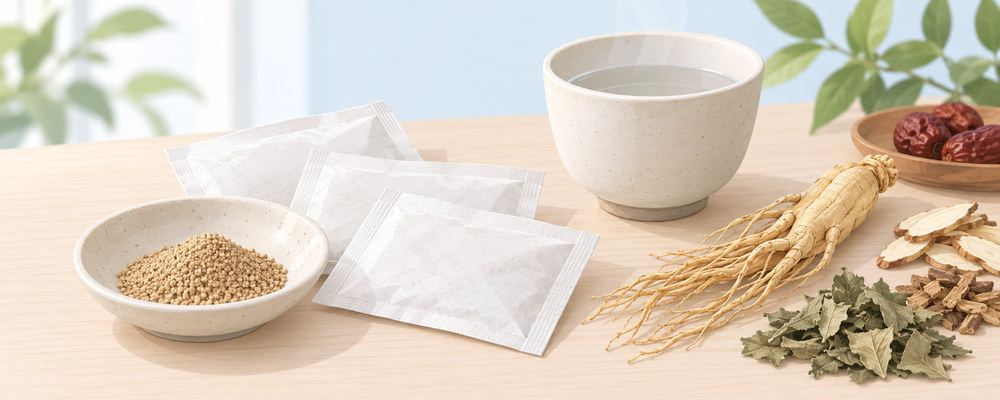
In traditional East Asian medicine, hyperhidrosis is viewed as a manifestation of “qi deficiency (lack of energy)” or “fluid stagnation (disrupted fluid metabolism),” and treatment aims to improve the overall constitution.
Herbal formulas commonly used for hyperhidrosis:
- 🌿 Boiogito (防已黄耆湯) … For those who tend to retain water and experience swelling
- 🌿 Hochuekkito (補中益気湯) … For those who fatigue easily and have a frail constitution
- 🌿 Keishikaogito (桂枝加黄耆湯) … For those who tend to sweat on the upper body
- 🌿 Saiko-keishi-kankyo-to (柴胡桂枝乾姜湯) … For those who are easily stressed and have a nervous disposition
⚠️ Important to Know: Effects often take several weeks to several months to appear, and dramatic improvement should not be expected. This approach is best considered as a complementary measure alongside other treatments.
💰 Cost: From ¥5,500 per month (tax included) / Some options are available over the counter at pharmacies
💉 Botulinum Toxin Injection | Reliable Suppression of Sweating for Several Months

This treatment involves injecting botulinum toxin into the affected area to temporarily block nerve signals to the sweat glands.
The preparations used are approved by Japan’s Ministry of Health, Labour and Welfare, and their safety has been confirmed. The treatment can be applied to a wide range of areas, including the underarms, palms, and soles of the feet.
The procedure takes approximately 15–30 minutes, and effects typically appear within 2–3 days and last for 4–9 months (results may vary between individuals). Re-injection is required when the effects wear off.
⚠️ Important to Know: There is some discomfort during injection (which can be reduced with a numbing cream). Insurance coverage applies only to severe axillary hyperhidrosis; all other cases are self-pay.
👉 Botulinum Toxin Treatment for Hyperhidrosis | Effect and Duration Explained in Detail
👉 Is Botulinum Toxin Treatment for Hyperhidrosis Covered by Insurance? Conditions and Costs Explained
💰 Cost: ¥22,000–¥55,000 (tax included) / session
For detailed pricing at our clinic, please refer to the Hyperhidrosis Price List.
⚡ Iontophoresis | An Insurance-Covered Treatment for the Hands and Feet
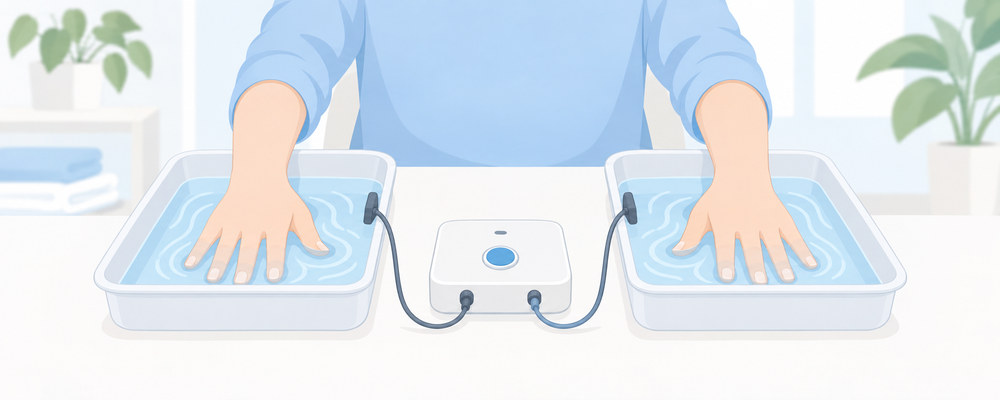
This treatment involves immersing the hands or feet in a water-filled tray and passing a mild electrical current (10–20 mA) to temporarily reduce the activity of the sweat glands.
Each session takes approximately 20–30 minutes. Attending 8–12 sessions at a frequency of 2–3 times per week is needed to see results, followed by maintenance treatment approximately once a week.
⚠️ Important to Know: This treatment is for the palms and soles of the feet only and cannot be applied to the underarms. The high visit frequency requires a certain amount of time commitment. While home-use devices are available, treatment at a medical facility tends to be more effective.
💰 Cost: Approx. ¥990 (tax included) / session (insurance covered)
🔪 Endoscopic Thoracic Sympathectomy (ETS) | A Curative Surgical Option for Palmar Hyperhidrosis
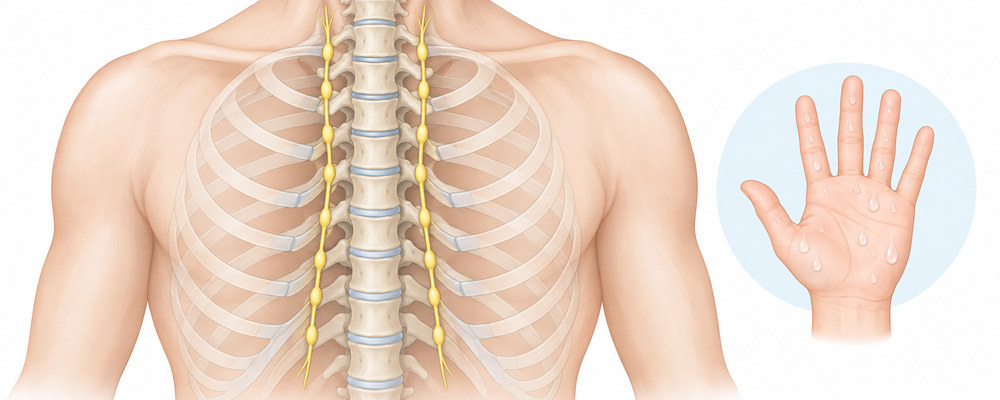
This surgical procedure involves making small incisions in the chest, inserting an endoscope, and cutting or cauterizing the sympathetic nerves that control sweating.
The reported effectiveness for palmar hyperhidrosis is over 95%, and each side takes approximately 15–20 minutes to complete. The incisions are only about 2–3 mm and are barely noticeable.
⚠️ Important Note: After surgery, compensatory sweating — excessive sweating in other areas such as the chest, back, abdomen, or thighs (compensatory sweating) — may occur. The incidence rate is relatively high at approximately 60–90%, and the extent varies between individuals. As some patients find compensatory sweating more troublesome than their original palmar symptoms, it is important to receive a thorough explanation and make a careful, informed decision.
💰 Cost: ¥132,000–¥165,000 (tax included) (insurance covered; based on 30% patient co-payment)
⭐ miraDry | A Non-Surgical Treatment That Targets Sweat Glands Without Incisions [Recommended at Our Clinic]
🌟 A Treatment Chosen by Many Patients at Our Clinic
A treatment that requires no incisions and may deliver long-lasting results
5 Reasons Why miraDry Is Chosen:
- ✅ No incisions, so no scarring
- ✅ Targets both eccrine and apocrine sweat glands → treats hyperhidrosis and underarm odor simultaneously
- ✅ Destroyed sweat glands do not regenerate, supporting lasting results
- ✅ FDA (U.S. Food and Drug Administration) approved
- ✅ Return to normal daily activities possible from the day after treatment (relatively short downtime)
The treatment takes approximately 60 minutes for both underarms. Local anesthesia is administered, so discomfort during the procedure is minimal. A reduction in sweating of around 70–80% may be expected from a single treatment session, and a second session can be considered if the initial results are insufficient.
👉 A Comprehensive Guide to miraDry’s Effects | Improvement Rate and Duration
👉 When Can You Start Noticing Results from miraDry?
👉 How miraDry Works: The Mechanism and Principles Explained in Detail by a Physician
💬 Comments from Patients Who Have Undergone Treatment
😊 “I was finally free from sweat marks that had bothered me for over 10 years.”
😊 “Since there was no incision, I was able to have the treatment without taking time off work.”
😊 “I was delighted that my odor concern was also addressed at the same time.”
For detailed pricing at our clinic, please refer to the Underarm Odor & Axillary Hyperhidrosis Price List.
🔬 How miraDry Works
Here is a 3-step explanation of how miraDry destroys sweat glands.
STEP 1: Identifying the Target
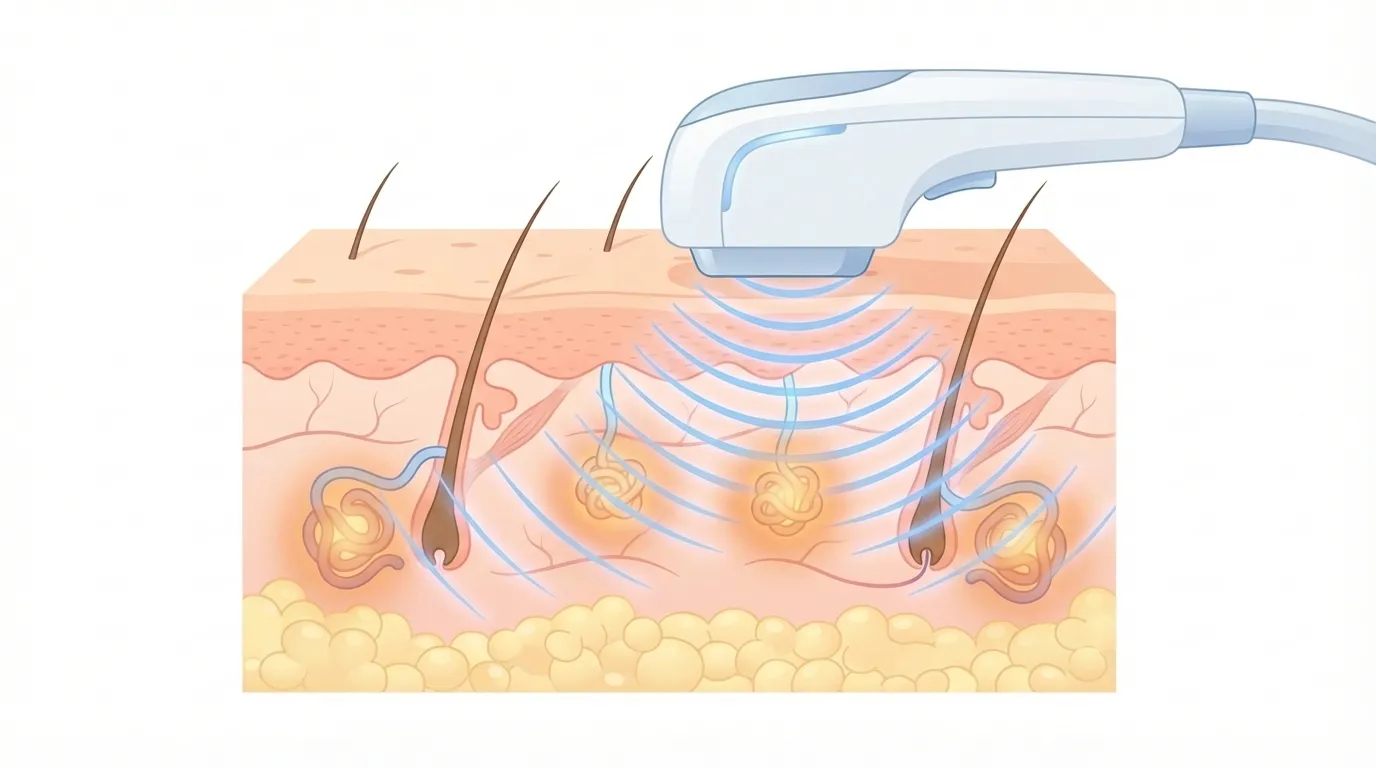
Beneath the skin of the underarms, eccrine sweat glands (responsible for sweating) and apocrine sweat glands (responsible for odor) are densely concentrated. These glands are located approximately 2–3 mm below the skin surface.
STEP 2: Thermal Destruction by Microwave Energy
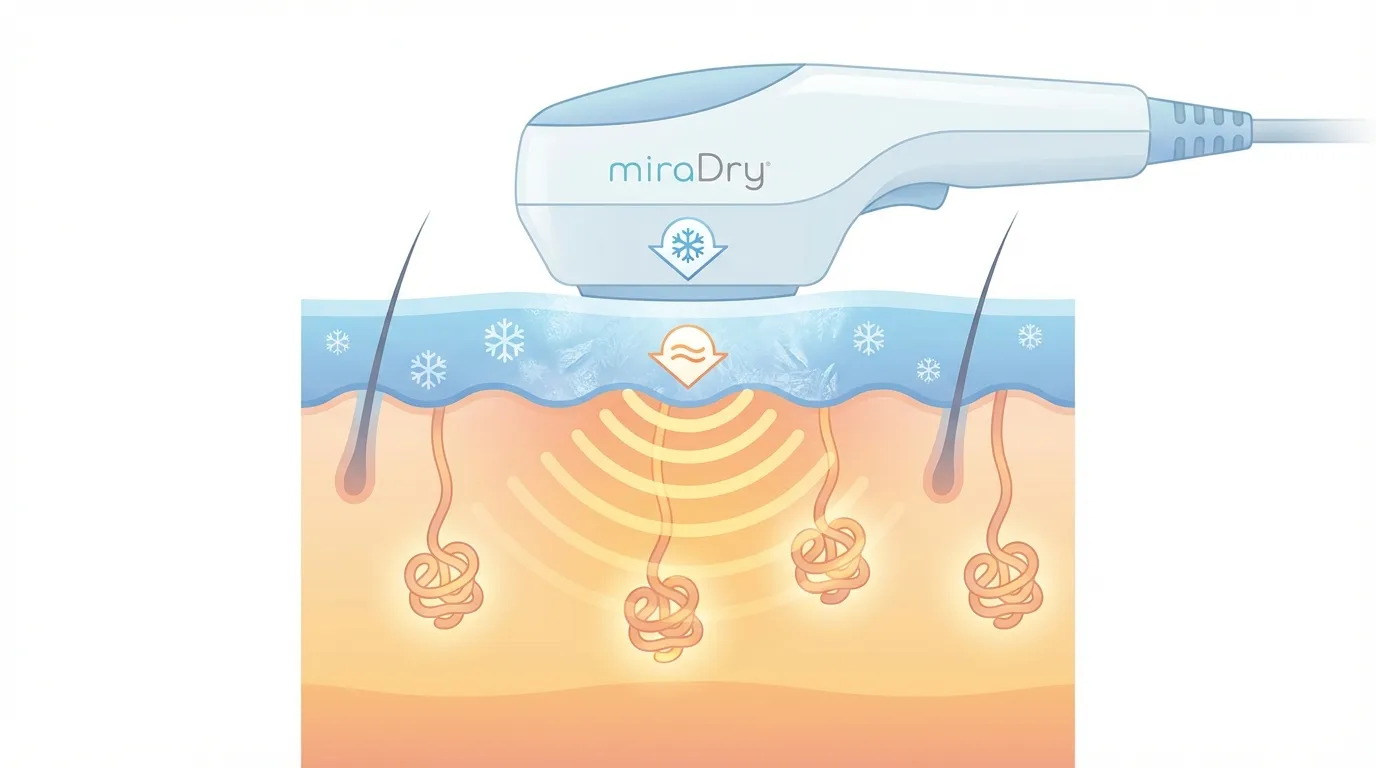
When microwave energy is delivered from the specialized handpiece, water molecules within the sweat glands vibrate and generate heat. The heat of 55–70°C coagulates and destroys the sweat glands.
STEP 3: Protecting the Skin Surface
A cooling system called “hydroCeramic cooling” operates simultaneously, protecting the skin surface while heating only the deeper tissue where the sweat glands reside. This helps minimize the risk of burns.
🏥 Why Patients Choose miraDry at IC Clinic Omiya
✅ This Treatment May Be Right for You If:
- 💧 You are concerned about both underarm sweating and odor
- 🔁 Continuing topical or oral medication for years feels burdensome
- 💉 You would prefer not to have repeated injections
- 🚫 You are hesitant about surgical procedures involving incisions
- ⏱️ You cannot take extended time off work or school
Medication-based treatments require ongoing use to maintain their effects, and botulinum toxin injections need to be repeated each time the effects wear off. Sympathectomy offers a high level of effectiveness but carries the risk of compensatory sweating.
miraDry is chosen by many patients as an option for addressing the root cause without incisions. While the initial cost may be higher, there are no ongoing treatment costs over the long term, making it a cost-effective option overall.
👉 miraDry Cost: Typical Prices and Why Fees Differ Between Clinics
👉 Is miraDry Covered by Insurance? Medical Expense Deduction Options Also Explained
If you are interested in miraDry treatment, please feel free to contact our clinic, which has extensive experience with this procedure.
💰 View IC Clinic’s miraDry Pricing Now

🏠 Enhancing Treatment Outcomes | Managing Hyperhidrosis in Daily Life
In addition to professional medical treatment, improving lifestyle habits to help control sweating is also important.
Please keep the following 3 key points in mind.
🥗 ① Limit Foods and Drinks That Stimulate the Sympathetic Nervous System
The following foods and drinks are known to activate the sympathetic nervous system and promote sweating:
- ☕ Caffeine (coffee, tea, energy drinks)
- 🌶️ Spicy foods (chili peppers, curry, etc.)
- 🍺 Alcohol (increases sweating through vasodilation)
- 🚬 Nicotine (tobacco)
It is not necessary to avoid these entirely, but limiting consumption before important occasions can help reduce sweating to a certain degree.

😌 ② Build Habits That Support Autonomic Nervous System Balance
Stress and tension activate the sympathetic nervous system and are a major trigger of “emotional sweating.”
The following habits can help balance the autonomic nervous system:
- 🛁 Warm baths at 38–40°C (activates the parasympathetic nervous system)
- 🧘 Deep breathing, meditation, and yoga (promote relaxation)
- 🏃 Moderate aerobic exercise (also helps train the sweat glands)
- 😴 Adequate sleep (allows the autonomic nervous system to recover)
Anxiety about sweating can itself trigger further sweating, creating a vicious cycle. It is therefore important to consciously make time to relax the mind and body.

🧼 ③ Take Good Care of Affected Areas After Sweating
Even with hyperhidrosis, addressing sweat promptly after it occurs can help prevent odor and skin problems.
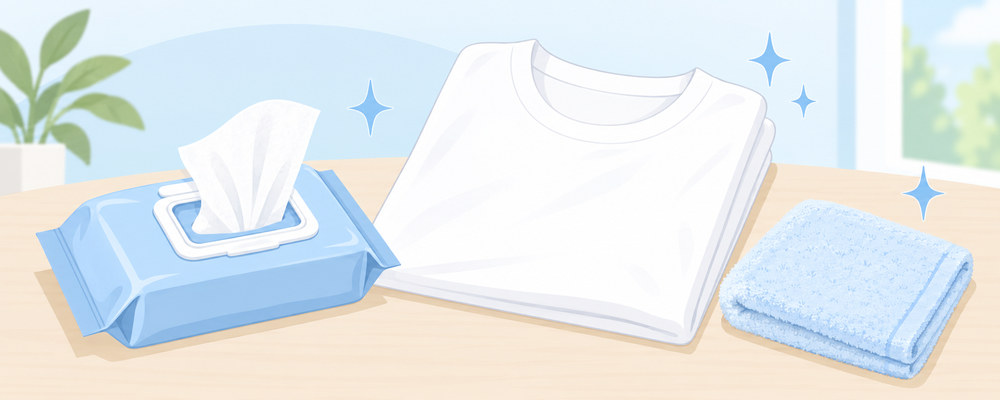
- 🚿 Wipe sweat away frequently (with a damp towel or sweat-wipe sheet)
- 👕 Wear moisture-wicking underwear (quick-dry fabrics are recommended over 100% cotton)
- 🎒 Carry a spare undershirt (change in a restroom when needed)
- 🧴 Use antiperspirant deodorant (apply in the morning and after wiping away sweat)
Sweat itself is odorless, but bacteria multiply over time and become the source of odor. Acting promptly is key.
❓ Frequently Asked Questions About Hyperhidrosis
Q1. What is the difference between being a heavy sweater and having hyperhidrosis?
Being a heavy sweater refers to a constitutional tendency to sweat easily, with sweating occurring in situations that require temperature regulation, such as when it is hot or during exercise.
Hyperhidrosis, on the other hand, is a condition in which excessive sweat is produced regardless of temperature regulation needs. If someone sweats heavily even in a cool room or while sitting still, and this interferes with daily life, hyperhidrosis may be a possibility.
Q2. Which medical department should I visit for hyperhidrosis treatment?
Hyperhidrosis can be assessed and treated at the following types of medical departments:
1️⃣ Dermatology … topical medication, oral medication, botulinum toxin injections, etc.
2️⃣ Plastic Surgery / Cosmetic Surgery … miraDry, surgery, etc.
3️⃣ Psychiatry / Psychosomatic Medicine … counseling for cases with a strong psychological component
Dermatology and plastic surgery offer the widest range of treatment options. Our clinic provides a broad range of treatments, from oral medication to miraDry.
👉 Which Department Should You See for Hyperhidrosis? A Guide by Symptom Type
Q3. Is hyperhidrosis hereditary?
Regarding primary focal hyperhidrosis (focal hyperhidrosis with no known cause), an association with family history has been reported. One survey found that approximately 60% of patients had a family member with similar symptoms.
However, environmental factors as well as genetic factors are thought to be involved, and findings differ across studies. Some individuals with a genetic predisposition do not develop the condition, while others with no family history do.
Q4. Can children receive treatment for hyperhidrosis?
Yes. Hyperhidrosis symptoms can sometimes be recognized as early as around age 3, and symptoms may worsen during adolescence in some cases.
For children, it is generally recommended to start with less burdensome treatments such as topical medication or iontophoresis. If symptoms are affecting your child’s school life or emotional well-being, please consult us as early as possible.
👉 Underarm Odor & Hyperhidrosis Treatment for Children | At What Age Can miraDry Be Performed?
Q5. What happens if hyperhidrosis is left untreated?
Hyperhidrosis itself is not life-threatening, but secondary problems may arise:
· Skin conditions (heat rash, eczema, fungal infections, etc.)
· Psychological distress (social anxiety, depressive tendencies, reduced self-esteem)
· Impact on social life (limitations on career choices, difficulties in personal relationships)
Rather than dismissing it as “just sweating,” if it is significantly impairing your quality of life, treatment is worth considering.
Q6. Can hyperhidrosis resolve on its own?
While there are reports suggesting that symptoms tend to ease with age, this is not the case for everyone. Many people continue to experience symptoms into their forties and fifties.
Rather than enduring the condition for years in the hope that it might resolve on its own, we encourage seeking appropriate treatment early and making the most of that time.
🏥 For Those Considering Hyperhidrosis Treatment in Omiya | About IC Clinic Omiya
“There are things I’ve given up on because of my sweating.” “I’ve become withdrawn because I’m always conscious of what others think.” — Many people share these kinds of concerns.
At our clinic, we propose a treatment plan tailored to each patient’s individual symptoms, lifestyle, and preferences.
Please start by telling us about your sweating concerns during a consultation. We will explain the treatment content, costs, and risks in detail, and proceed only once you are fully satisfied.
For detailed pricing on underarm odor and axillary hyperhidrosis treatments at our clinic, please visit the Underarm Odor & Axillary Hyperhidrosis Price List.
🎯 Wouldn’t You Like to Live Your Days Without Worrying About Sweat?
✅ Freely choose clothes in any color or style you like
✅ Raise your hand confidently in front of others
✅ No longer hesitate to shake hands or give a high-five
✅ Be free from the constant worry of “Is my sweating okay right now…?”
Start with a specialist consultation to find the right treatment for you
📚 Hyperhidrosis-Related Articles
For those who would like to learn more about hyperhidrosis, please see the related articles below.
【Hyperhidrosis Basics】
- 👉 How to Self-Check for Hyperhidrosis | How to Identify Your Symptoms
- 👉 Hyperhidrosis and Stress | Causes and Management of Emotional Sweating
- 👉 Which Department Should You See for Hyperhidrosis? A Guide by Symptom Type
- 👉 Is Excessive Sweating a Sign of Hyperhidrosis? Causes and Treatment Explained
- 👉 Severe Sweating on the Head and Face: Causes and Management of Craniofacial Hyperhidrosis
【Hyperhidrosis Treatments】
- 👉 Types of Hyperhidrosis Surgery | Advantages and Disadvantages by Treatment
- 👉 Botulinum Toxin Treatment for Hyperhidrosis | Effect and Duration Explained in Detail
- 👉 Is Botulinum Toxin Treatment for Hyperhidrosis Covered by Insurance? Conditions and Costs Explained
- 👉 Insurance Coverage for Hyperhidrosis Treatment | Which Treatments Are Covered and Under What Conditions
📚 Underarm Odor (Axillary Osmidrosis)-Related Articles
For those who would also like to learn more about underarm odor (axillary osmidrosis), which frequently occurs alongside hyperhidrosis, please see the related articles below.
【Underarm Odor Basics】
- 👉 Characteristics and Symptoms of Underarm Odor | Self-Check Method Also Explained
- 👉 How to Self-Check for Underarm Odor | Key Points for Assessing Yourself
- 👉 The Connection Between Underarm Odor and Earwax | Is Wet Earwax a Sign of Axillary Osmidrosis?
- 👉 Can You Have Wet Earwax Without Underarm Odor? How to Tell the Difference
- 👉 Is Underarm Odor Hereditary? The Genetics and How to Address It
- 👉 Causes of Underarm Odor and Heredity | A Physician’s Explanation of Why It Develops
- 👉 Can Underarm Odor Spread to Others? A Physician Sets the Record Straight
【Underarm Odor Treatments】
- 👉 Types of Underarm Odor Treatment and Comparisons | How to Choose the Right Option for You
- 👉 Underarm Odor Management Overview | From Self-Care to Medical Treatment
- 👉 Botulinum Toxin Treatment for Underarm Odor | Effect and Duration Explained
- 👉 How to Find a Skilled Surgeon for Underarm Odor Surgery | Choosing a Clinic Without Regrets
- 👉 How Long Is the Downtime After Underarm Odor Surgery? Explained by Treatment Type
【Underarm Odor Treatment Costs & Insurance】
- 👉 Insurance-Covered Underarm Odor Treatments | Which Treatments Are Covered and Under What Conditions
- 👉 Insurance Coverage Conditions for Underarm Odor Treatment | Criteria for Receiving Covered Care
- 👉 Typical Costs of Underarm Odor Surgery | Insurance Coverage Conditions Also Explained
- 👉 A Detailed Cost Comparison for Underarm Odor Surgery | Estimated Fees by Treatment Type
- 👉 Is Underarm Odor Treatment for Children Covered by Insurance? Treatment Options and Costs Explained
【Comprehensive Underarm Odor Treatment Page】
📚 miraDry-Related Articles
For those who would like to learn more about miraDry, a non-surgical treatment for underarm odor and hyperhidrosis, please see the related articles below.
【miraDry Effects & Mechanism】
- 👉 About miraDry Treatment | Non-Surgical Treatment for Underarm Odor & Hyperhidrosis in Omiya
- 👉 A Comprehensive Guide to miraDry’s Effects | Improvement Rate and Duration for Underarm Odor & Hyperhidrosis
- 👉 Is miraDry Ineffective for Underarm Odor? A Physician Explains the Causes and How to Maximize Results
- 👉 When Can You Start Noticing Results from miraDry? How Long Until Effects Appear
- 👉 How miraDry Works: The Mechanism and Principles Explained in Detail by a Physician
- 👉 Is miraDry Effective for Treating Underarm Odor?
【miraDry Cost & Insurance】
- 👉 miraDry Cost: Typical Prices and Why Fees Differ — Plus Tips on Medical Expense Deductions and Choosing a Clinic
- 👉 Is miraDry Covered by Insurance? Medical Expense Deduction Options Also Explained
【Addressing Concerns Before miraDry Treatment】
- 👉 7 Reasons People Regret miraDry | What to Know Before Treatment, Supervised by a Physician
- 👉 7 Drawbacks of miraDry | A Physician’s Guide to Side Effects, Limitations, and Costs — So You Don’t Have Regrets
- 👉 Has Anyone Died from miraDry? A Physician Thoroughly Examines the Facts and Safety
- 👉 Did Odor Get Worse After miraDry? A Specialist Explains the Causes and What to Do
- 👉 Is miraDry “Ineffective”? A Physician Addresses Those Considering Treatment in Omiya
【miraDry Treatment for Children】
- 👉 Underarm Odor & Hyperhidrosis Treatment for Children | At What Age Can miraDry Be Performed?
- 👉 Is miraDry Effective for Junior High School Students with Underarm Odor or Hyperhidrosis? What to Know Before Considering Treatment in Omiya
【For Those Looking for miraDry in Saitama】
- 👉 For Those Looking for miraDry in Ageo | Non-Surgical Treatment for Underarm Odor & Hyperhidrosis Available in Omiya
- 👉 For Those Living in the Urawa Area | A Guide to miraDry Treatment for Underarm Odor & Hyperhidrosis
- 👉 For Those Considering miraDry in the Yono Area | A Specialist’s Detailed Explanation of Treatment Features and Effects
- 👉 miraDry for Underarm Odor & Hyperhidrosis | IC Clinic Omiya — Conveniently Accessible from the Saitama-Shintoshin Area